Wednesday, May 13, 2026
As a University of North Texas Distinguished Research Professor of UNT, Jincheng Du considers himself a lifelong learner.
“As a researcher, one needs to stay curious,” Du said. “With that mentality, I’m learning new things that can lead to discoveries almost every day, and I use that as encouragement for my students.”
Du is also the chair of the materials sciences and engineering department within the College of Engineering where he leads one of the most research active units on campus. His lab focuses on using advanced computer simulations and characterizations to understand materials’ atomic and micro structures and how they affect the properties of glass and ceramic materials. He has recently been elected as a Fellow of the American Association for the Advancement of Science (AAAS). He is being honored for distinguished contributions to materials chemistry, particularly in developing atomistic simulation methods for inorganic glasses, ceramics, and related materials, with applications in energy storage, biomedicine, and nuclear waste management. In addition to AAAS, he is also an elected fellow of the American Ceramic Society and ASM International, two prime societies in the field of materials science and engineering.
“It is of course a great honor. I am really happy and grateful for the recognition,” Du said. “I started as an assistant professor here in 2007, and to be where I am now, I’m just really grateful for what has been provided to me at UNT.”
At the center of Du’s work is his Functional Glasses and Materials Modeling Laboratory that welcomes undergraduate and graduate students from multiple disciplines, including Texas Academy of Mathematics and Science students. He advises them on their research projects, pushes them on research excellence, and mentors them on career aspirations. He pushes boundaries of materials research and education not only through his teaching and research but also through services in various societies: for example, he is an Editor of the Journal of the American Ceramic Society and he is also Vice President of the International Council of Materials Education (ICME).
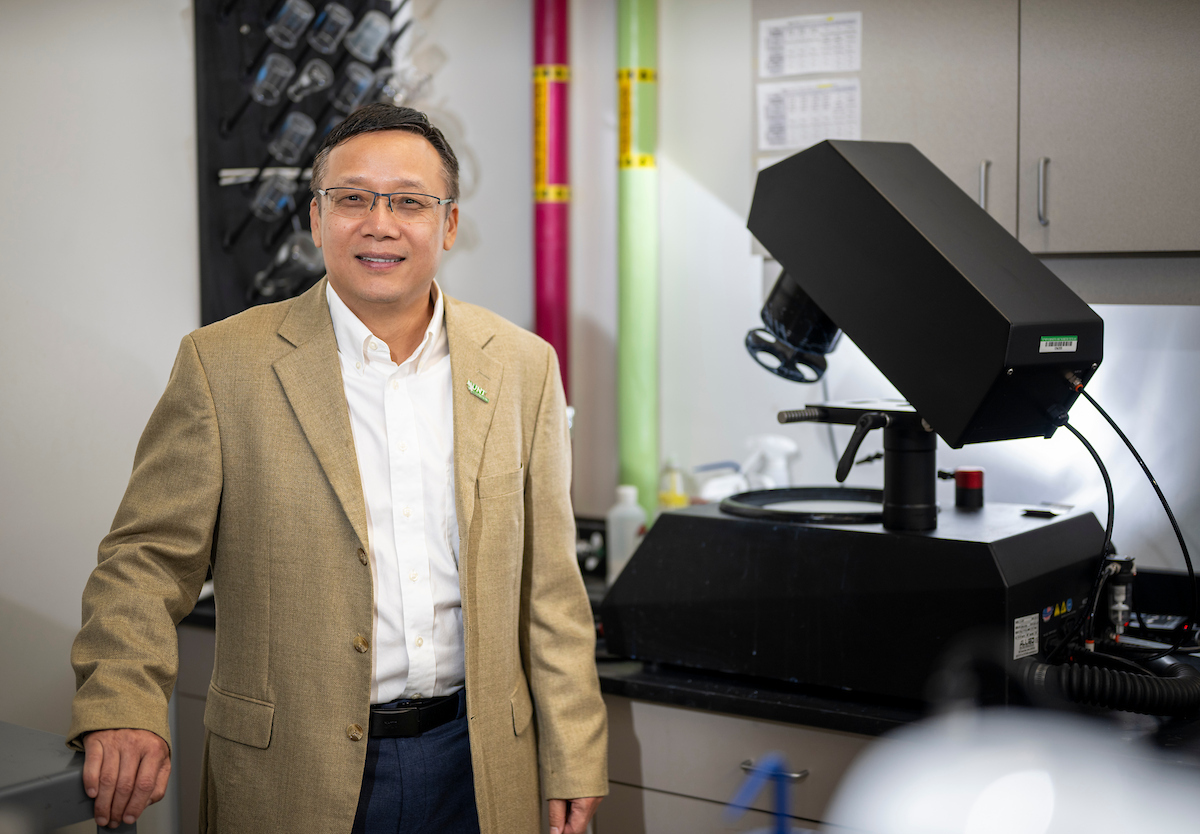
UNT's Distinguished Research Professor Jincheng Du develops atomistic simulation methods for inorganic glasses and ceramics.
“We have had master and doctoral graduates graduated from our group who are now working in industry, academia and national labs. And just the other day, a student who became an assistant professor wrote to me that she got her first grant,” Du said. “It’s very nice as a mentor to hear your former student being successful on his or her career paths. This one of the most rewarding moments of being an educator.”
Du and his students’ work focus on using inorganic glasses and ceramics for three different areas of applications: biomedical, energy and nuclear applications by integrating advanced computer simulations and materials characterizations.
For the first, he and his lab create bioactive materials that will react with the body and help promote healing, with use cases ranging from dental to orthopedic.
“We had a project on developing bioactive glass coating on titanium alloy based implant materials. The metal doesn’t hurt the body (being bioinert), but this layer acts as a bridge between our body and the implant so it can integrate more closely.”
The second application is related to solid state electrolytes for battery and energy storage applications. Current batteries use liquid electrolytes to transport ions, but that can cause issues like leaking or overheating that lead to safety issues. In his lab, Du and his students work on the synthesis and design of solid state electrolytes, which are solids that can conduct electricity through ion transport, by using atomistic computer simulations and advanced characterizations for solid state batteries that are safer and with higher power density.
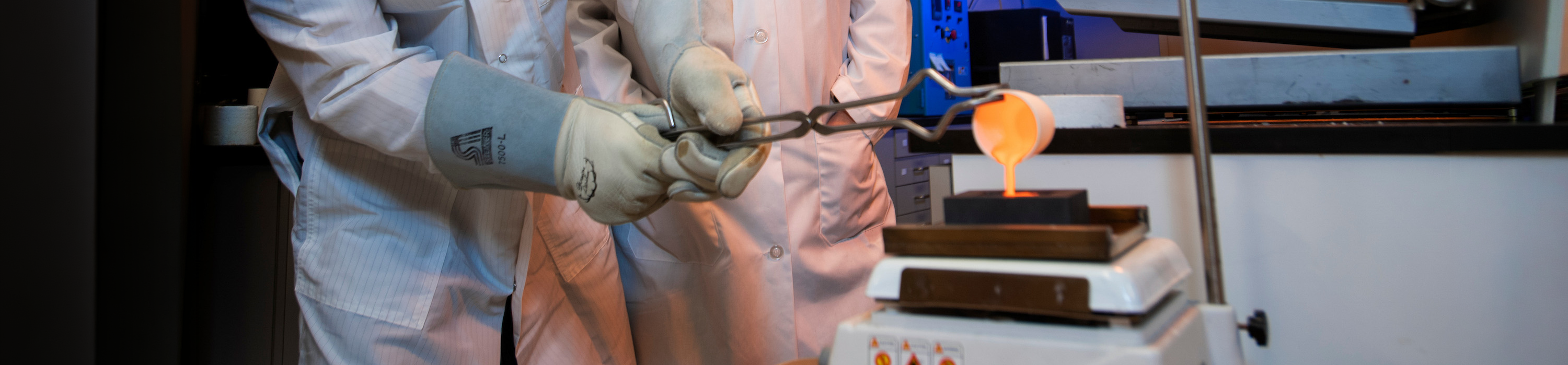
The third application, which Du has been researching for over a decade, is for nuclear energy and environmental applications. Nuclear energy creates radioactive waste that must be properly treated and stored. Typically, this is done by melting the waste with a mixture of other materials and turning it into a glass, a process known as vitrification. This immobilizes the waste and radioactive elements in the solid glass so it can be stably stored for hundreds of thousands of years. He has been collaborating with researchers from national laboratories including the Pacific Northwest National Laboratory and industry such as Citrine Informatics on several DOE funded projects.
“Next-generation nuclear energy will be needed to support ever increasing energy needs and new technologies such as data centers because they take so much energy,” Du said. “One of the important areas in nuclear energy is how to treat and immobilize radioactive wastes to make it a sustainable energy source. It’s a grand challenge in science and technology and is critical to solve both energy and environmental issues in our society.”
That drive for improving society is Du’s motivation behind all of his research.
“I hope our research can have an impact on our society. We are performing research to advance science, engineering and innovation while educating the next generation of scientists and engineers.”
From UNT News – Research