Friday, February 20, 2026
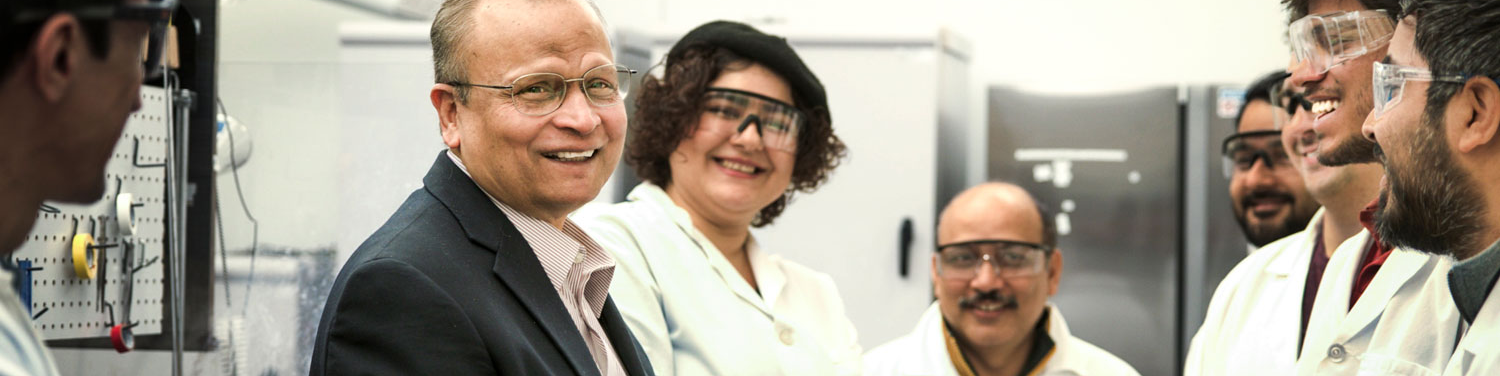
UNT's Dr. D’Souza - 2025 Eminent Faculty Award Winner with a few graduate students
Driven by curiosity and a commitment to building a better future, Regents Professor Francis D’Souza is being recognized for his hard work. D’Souza is a Regents professor in the University of North Texas (UNT) College of Science’s Chemistry department, being recognized by the Society of Porphyrins and Phthalocyanines with the Hans Fischer Career Award for Lifetime Achievement.
“It’s a great honor because you know the community has accepted you to be a leader in this field,” D’Souza says. “It also complements the Eminent Faculty Award I received from UNT last year, so these two make my hard work worthwhile.”
D’Souza began his career as an independent researcher at Wichita State University in 1994. He joined UNT in 2011 and is recognized as an expert in fundamental and applied porphyrin chemistry, collaborating with researchers worldwide. He’s served as program director at the National Science Foundation, is a Senior Vice President in The Electrochemical Society, and serves as a Vice President for the Society of Porphyrins and Phthalocyanines.
Porphyrins are building-block molecules that enable oxygen transport in life, such as heme in hemoglobin and chlorophyll in photosynthesis. The NSF and the Department of Energy have funded his research into the molecules for the past two decades.
“What we try to do is to mimic photosynthesis by making molecules that can capture sunlight and then convert it into electricity or produce fuel, such as hydrogen.”
D’Souza also conducts research in chemical sensing. Mainly, building systems that
can recognize and provide a signal when they sense targeted molecules, such as toxic
agents in the atmosphere or cancer biomarkers.
YouTube Video 5:42 | Dr. Francis D’Souza - 2025 Eminent Faculty Award Winner
“We also have a Welch grant where my colleagues at UNT and I are studying catalysis. That’s on converting nitrogen from air or nitrate from water and soil into ammonia, a base compound to manufacture fertilizers,” D’Souza says. “So, the three chemistry focuses in my lab are energy harvesting, sensing, and catalysis.”
D’Souza says he gravitates towards energy-related projects because of their implications for the future.
“Sooner or later, our fossil fuels are going to run out. We need alternative energy sources so that the next generation and the one after can enjoy a high standard of living. It’s important to see our civilization grow in a better fashion.”
As another way to shape the future, D’Souza mentors multiple students in his lab and teaches advanced graduate and undergraduate chemistry courses, including advanced spectroscopy, electrochemistry, and analytical chemistry. He’s overseen more than 75 undergraduate research projects and more than 35 graduate theses and dissertations.
“Teaching is very important. I love teaching,” D’Souza says. “Some students show their curiosity in a research path and ask a zillion questions. I want to provide as much information as possible so they can make the right decision about their future, and that is very rewarding.”
D’Souza says his love of chemistry and teaching reflects his own experience in school.
“I had a fantastic teacher in high school who used to give a lot of demonstrations and motivated me to go to graduate school for chemistry,” he says. “Obviously, I had other good teachers, and they all molded me to be the chemist I am today. Even today, I still think chemistry is fun.”
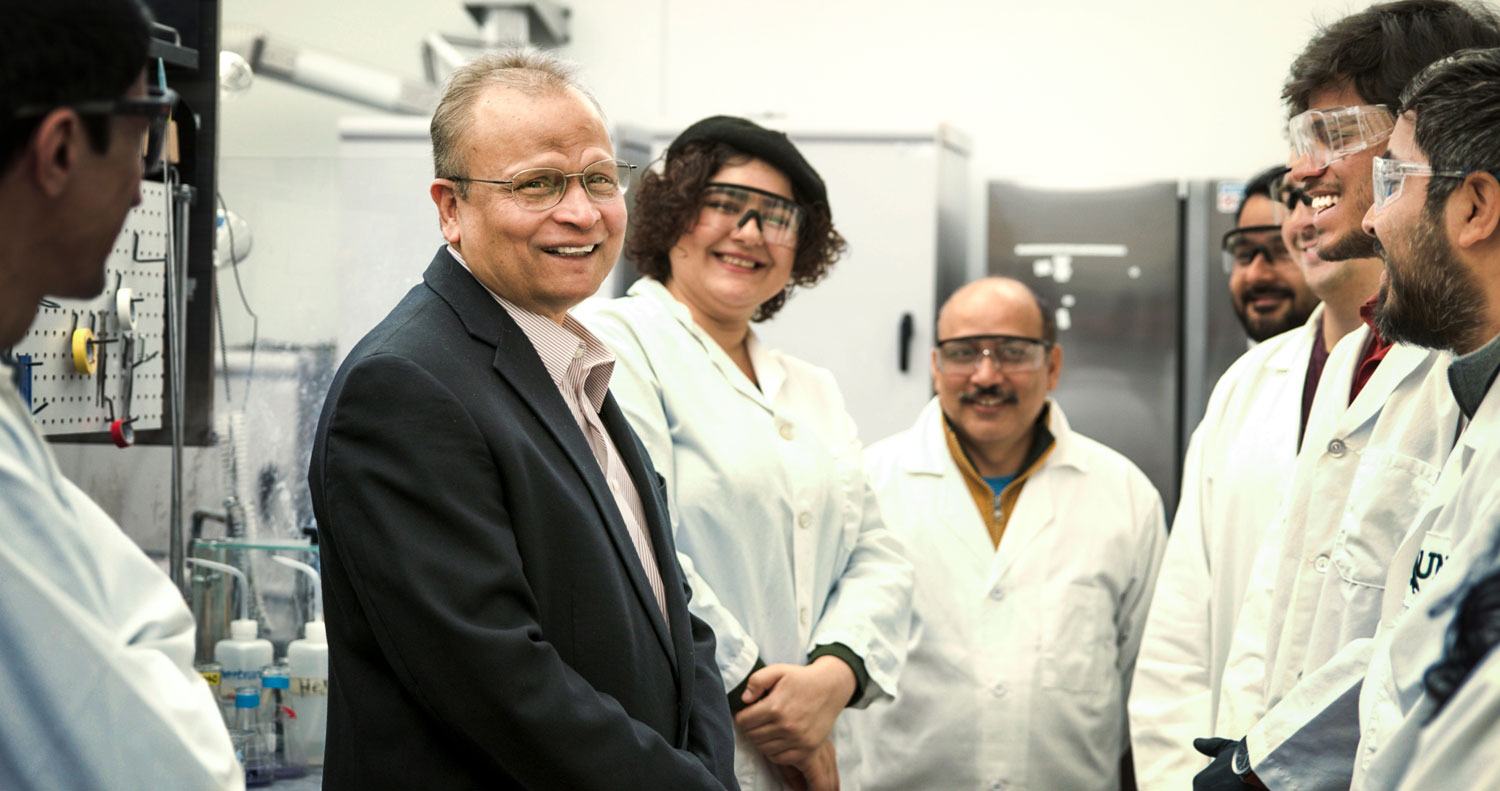 He hopes to bring that same love of chemistry to his students today.
“I’ve had many students go on to national labs, choose the academic life, or go into industry. Some of them are doing better than I am now, and that’s great. At the end of the day, what matters is making sure they’re set up for success.”
He also thanks UNT for its help in creating his and his students’ success stories, as well as the support and resources it provides.
“We have a state-of-the-art facility in our lab. Without UNT’s support, we could not do that outstanding science, so I am very thankful for what they have done for us.”
Looking ahead to future projects, D’Souza says there’s no specific project in mind, as topics often arise from his current projects.
“Every time you do research, something else pops up that becomes a new opportunity, a new problem to solve. All we can do is continue to learn, accumulate that knowledge, and pass it on to the next generation so they can be prepared for their futures. That is my main task as a teacher and researcher.”
From UNT News – Research: by Amanda Lyons