Tuesday, December 16, 2025

DENTON (UNT), Texas — The Center for Information and Cyber Security (CICS) at the University of North Texas has been named a finalist in the annual Innovation Awards, presented by D CEO and Dallas Innovates to honor innovation across the region. This year, the center is a finalist in the Innovation in Education category and is the only higher education entity represented.
“We are very excited for this award because we believe our project is something that has never been done before and will advance workforce development,” said Ram Dantu, director of the center and a professor of computer science and engineering.
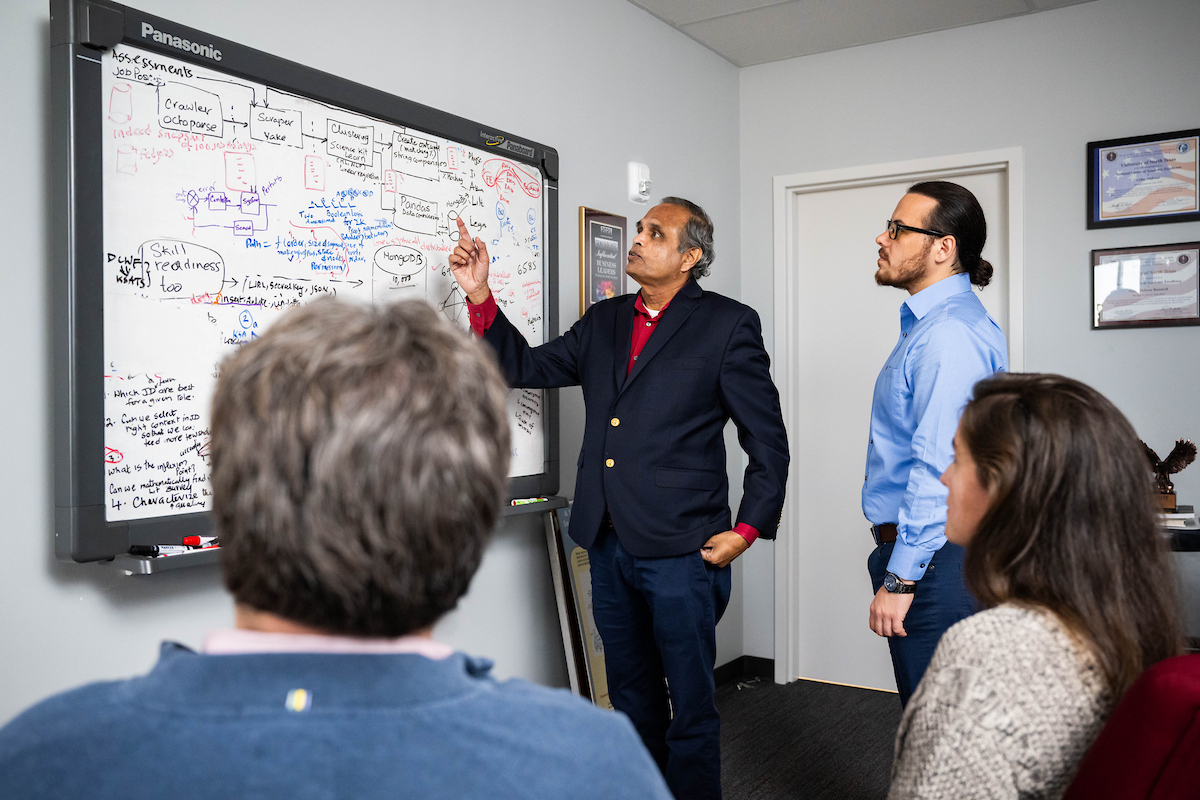
The UNT center is nominated for its Microtranscript program, a work-skills readiness program.
CICS is an interdisciplinary group with faculty members from the College of Engineering, College of Information and the G. Brint Ryan College of Business. Its mission is to promote education, research and service projects that strengthen cybersecurity and provide high-quality coursework for students in the field.
The project nominated for the award is called Microtranscript, a work-skills readiness tool. The program breaks down student’s coursework to highlight specific skills learned and how the student performed in each area.
“Normally, a student only has a transcript, but that doesn’t tell hiring managers if they’re proficient in a programming language or not,” Dantu said. “This breaks down their course into usable skills and scores them as beginner, intermediate and advanced.”
For example, a Microtranscript can take a course such as Foundations of Cybersecurity and break it into categories such as cyberterrorism, cyber-assisted crimes and federal laws and authorities. Dantu said the program will help interns in the computer science and engineering start contributing more quickly when hired.
“Most internships last around three to four months, but it takes students around that long to get up to speed,” he said. “This way they’re productive from day one and are ready to help on a small module of a larger project.”
Microtranscript is currently built for computer science and engineering skills, particularly in cybersecurity. Dantu said he and his graduate students working on the project use knowledge units specified by the National Security Agency to structure the program. They are also working to expand it for other engineering disciplines and biology.
“The beauty of Microtranscript is that it can be adapted for any discipline that has a national association or agency that defines certification standards,” he said.
Instructors assign applicable knowledge units to the rubric for an assignment, such as a quiz. The student’s grade then translates into points towards the knowledge unit, with 100 as the highest score. In its current trial form, the microtranscript is tied to one class, but the goal is for it to follow a student through their college career, updating as they complete new courses.
“It adds a new level of trust with companies,” Dantu said. “The microtranscript is authenticated by the professor and shows that a student applicant knows the skills they say they have.”
The program is being piloted at UNT, the University of New Haven, Tennessee Technological University and the University of Hawaii. After the first trial concludes in 2026, Dantu said they plan to expand it in stages to 30 additional universities across the country.
The Microtranscript program is funded through a $3 million Department of Defense grant. It is part of a larger effort to modernize the DoD’s hiring and upskilling processes. The initiative uses advanced AI to assess employees’ skill levels and recommend suitable jobs and certificates to help them advance.
“This is all aimed at streamlining hiring while also providing clear pathways for individuals to upskill and qualify for highly specialized roles,” Dantu said. “We’re excited to get this rolled out to other universities and hopefully see it expand to other fields and government agencies.”
From UNT News – Research