Tuesday, February 17, 2026

UNT NSF grant study examines warming effects on freshwater stream ecosystems
DENTON (UNT), Texas — Research taking place at the University of North Texas aims to challenge conventional thinking in the world of ecology. Typically, research shows that organisms in warmer temperature waters mature faster and reach smaller adult sizes than those in cooler temperatures.
“What we’ve been seeing in the wild is the opposite,” said Jim Junker, a research assistant professor in the College of Science. “There’s a lot more bigger organisms than we expected compared to the amount of smaller organisms. Our goal is to get in there and disentangle the mechanisms behind this.”
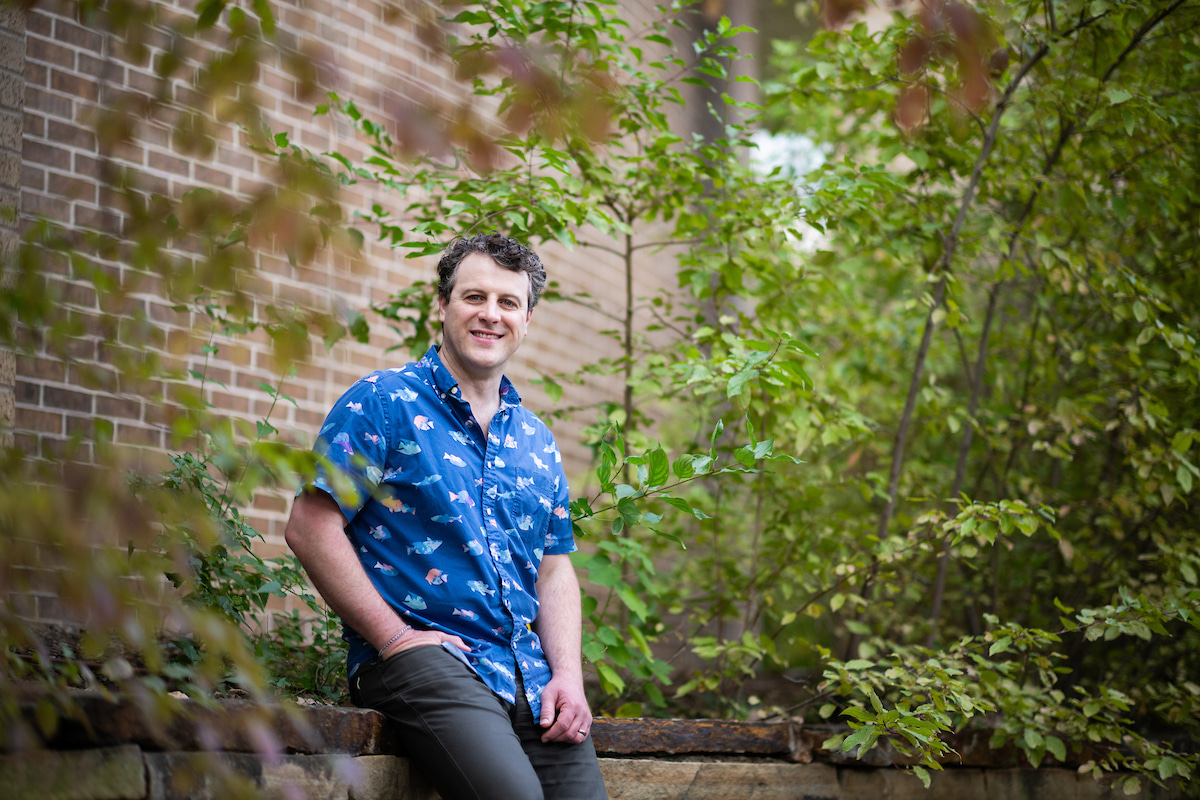
UNT College of Science's Jim Junker
Junker is one of the principal investigators on the project alongside two colleagues, Jeff Wesner from University of South Dakota and Justin Pomeranz from the Colorado Mesa University. This latest grant from the National Science Foundation is the next step in their effort to understand how temperature, energy availability, and body size combine to shape freshwater food webs.
“Body size distribution is a dominant driver for lots of biological and ecological functions. It shows us how energy moves through an ecosystem from algae up to larger predators,” Junker said.
Traditional lab experiments suggest that warming temperatures lead to smaller body sizes and less energy reaching top predators.
“However, a lot of those experiments are built on thinking of systems as closed,” Junker said. “Well, natural streams are open and collect all kinds of things from the landscape like fallen leaves or acorns.”
To test these ideas in real-world systems, Junker and his team will visit streams maintained by the National Ecological Observatory Network, a program sponsored by the National Science Foundation. They’ll be going to 24 different sites across the U.S., including Puerto Rico and Alaska. This will allow them to study ecosystems at various temperatures, latitudes and longitudes, and with varying sunlight availability.
“There’s some hope that we’ll discover patterns that can let us make predictions as to how these systems may change in the future. For instance, as northern latitudes warm, they may change to reflect current ecosystems at lower latitudes.”
For field research, the team’s most important tool is a ruler. They’ll be measuring the size of insects and fish in the streams. They’ll also catch some and place them in containers to measure the change in oxygen over time to calculate the metabolic rate of each creature as a proxy for its energy use. Junker sees this work as a good opportunity for students to get hands-on experience.
“We have two sites within an hour’s drive of UNT, so I’m hoping to involve a lot of undergrad researchers at UNT to help,” Junker said. “Ideally, they’ll be able to create their own projects from this to help answer smaller questions that come from the work.”
The grant, around $550,000, lasts for three years. The plan is to perform trial data collection in the spring with a full campaign planned for 2027. The teams will split into three groups and split up the U.S. with meet ups at the start and end.
“We’re very excited about this project,” Junker said. “It’s a meeting between science’s control and nature’s chaos and realism to lead us to a better understanding of what we know of the world at large.”
From UNT News – Research